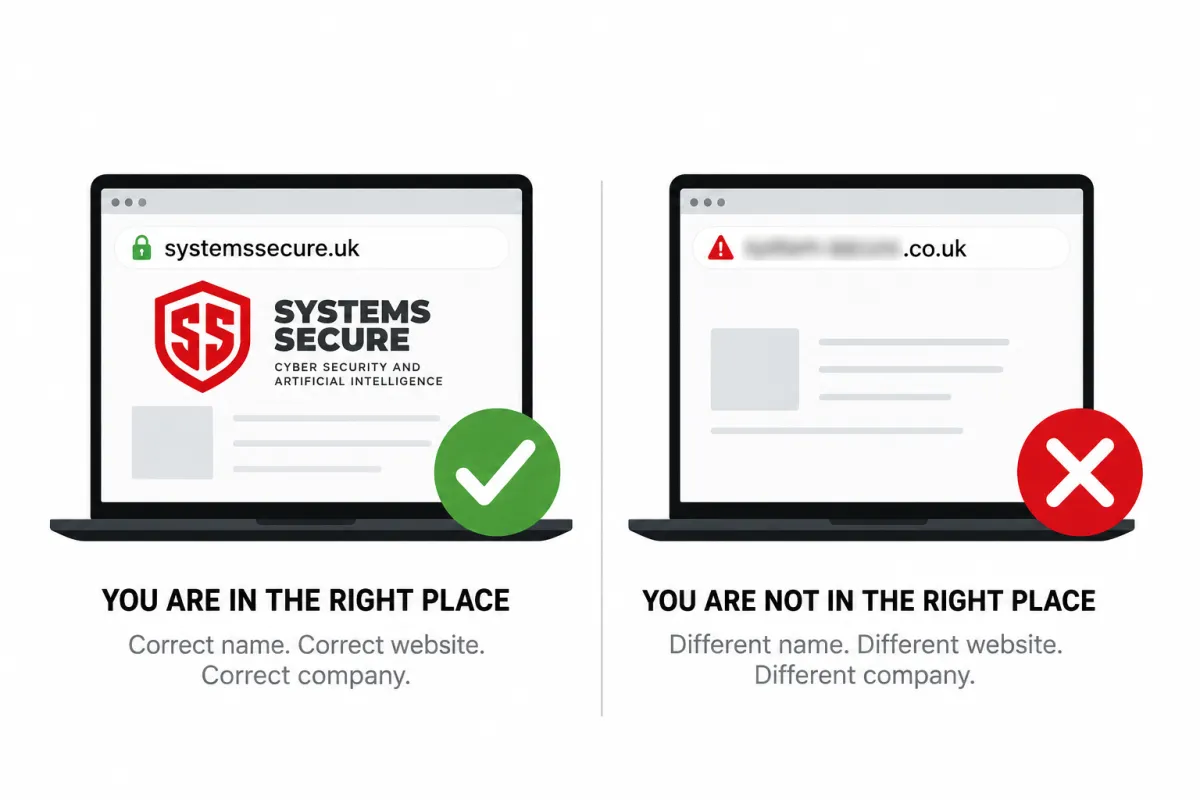
There is another company with a name very like ours. We are not connected.
The short version: a cyber security firm operating in the UK has a name almost identical to ours. We have no connection with them — no shared ownership, no partnership, no staff in common. Recently a search engine mixed the two of us up and showed my name and my professional qualifications next to the other firm's website address and telephone number. If you are a client of mine, this page tells you how to be certain, every time, that you are dealing with us.
What actually happened
Searching for me by name produced a result that put my details — my name, my qualifications — alongside a different company's contact details.
Nothing sinister is going on. Search engines and AI assistants build a picture of a business by collecting fragments from all over the web and stitching them together. When two companies have names one letter apart, both sell cyber security, and both are registered in England, some of those fragments end up in the wrong pile. It is a machine making a reasonable mistake, not a person doing anything wrong.
I want to be clear about something before I go any further: I am not suggesting the other company is anything other than a legitimate business getting on with its work. I know nothing to their discredit and this page is not a complaint about them. They were almost certainly unaware of us when they chose their name, just as we were unaware of them. The problem is the confusion itself, not either company.
Why I am bothering to tell you
In most industries a mix-up like this is an irritation. In mine it is a risk, for three reasons.
First, the phone number. If you ever look us up rather than using the number you already have, and the number you find belongs to somebody else, you will have a conversation about your security with a company that isn't us.
Second, invoices and payment details. Impersonating a supplier is one of the most common frauds aimed at small businesses. It works because it does not need any clever technology — it only needs the victim to be slightly unsure who they are dealing with. Name confusion hands that uncertainty over for free.
Third, it undermines the thing I sell. I ask clients to be sceptical about unexpected emails, to verify before they act, and to trust the checkable over the plausible. I can hardly ask that of you and then leave you guessing about my own identity.
How to be certain you are dealing with us
Every detail below can be checked independently. Nothing here relies on taking my word for it.
You can verify the company number yourself at Companies House — search 07295869 and you will find Systems Secure Limited, along with our full filing history back to 2010. That is the single most reliable check there is, and it takes about twenty seconds.
Two things worth noting. Ours is Systems Secure, with an "s" on the end of "Systems". And our web address has no hyphen in it: systemssecure.uk. If you land somewhere spelled differently, you are somewhere else.
If anything ever looks wrong
Ring the number you already have for me. Not one from a search result, not one from an email signature, not one from a text message. The number in your own phone or on an old invoice is the one that hasn't been tampered with.
Never change payment details on the strength of an email alone. If you receive anything claiming our bank details have changed, they have not. Ring me and check. This applies to every supplier you have, not just us.
When in doubt, forward it to me. I would far rather look at ten things that turn out to be fine than miss the one that isn't. There is no charge for asking and I have never once thought a client was wasting my time.
The wider point, which applies to every supplier you use
This particular mix-up is an accident. But attackers create the same confusion deliberately, and it is one of the cheapest tricks they have.
They register a domain a single character away from a real one — an extra letter, a missing hyphen, .co instead of .co.uk — and send invoices from it. They set the display name on an email account to your accountant's name, so your phone shows a familiar name above an unfamiliar address. They spoof caller ID so an incoming call looks like it is from your bank.
Three habits defeat almost all of it:
Verify a change of details out of band. If the request arrives by email, check it by phone. If it arrives by phone, check it by email. Never verify a channel using that same channel.
Read the whole address, not the display name. On a phone, the sender's real address is usually hidden behind a friendly name. Tap it.
Agree in advance that anyone can pause a payment. Most invoice fraud succeeds because somebody junior felt awkward about querying something urgent from somebody senior. Remove the awkwardness in advance and you remove the attack.
What we are doing about it
We are correcting the record where we can: making sure the machine-readable company details on our website are complete and consistent, claiming and confirming our listings with the search engines, and tying the site, the company registration and my professional profile together so that they are unmistakably one entity.
Search engines and AI assistants do not update instantly, and some of them will probably keep getting it wrong for a while yet. That is exactly why this page exists: so there is a plain, checkable answer sitting somewhere they can find it — and somewhere you can find it too.
If you have any doubt at all about who you are talking to, ring me on 07702 896910.
James Batt Systems Secure Limited